Reading the Room: Performance, Prestige, and Visibility in Wesleyan University’s Smith Reading Room
Since my freshman year, I have always done my work in Wesleyan’s main academic library, Olin. It has become one of the defining spaces of my Wesleyan career, the place I most associate with the practice of learning. It felt only natural, then, that for my Crafting Ethnography class, I chose Olin as the site for my fieldwork.
At first, I was set on conducting an ethnography of the Wesleyan archives, imagining it as a way to trace how personal and narrative details get captured, preserved, and mediated on paper, as well as by those who care for it. I was drawn to the idea of treating the archive not just as a storage space but as a site of knowledge production; where non-human actors, documents, cataloguing systems, finding aids, even the silences within collections, shape what can be known. When I asked about the feasibility of this project, however, the University Archivist explained that the staff was too small to host me in that capacity. I was crushed but knew that my ethnography still had to take place in Olin, but the question remained: where?
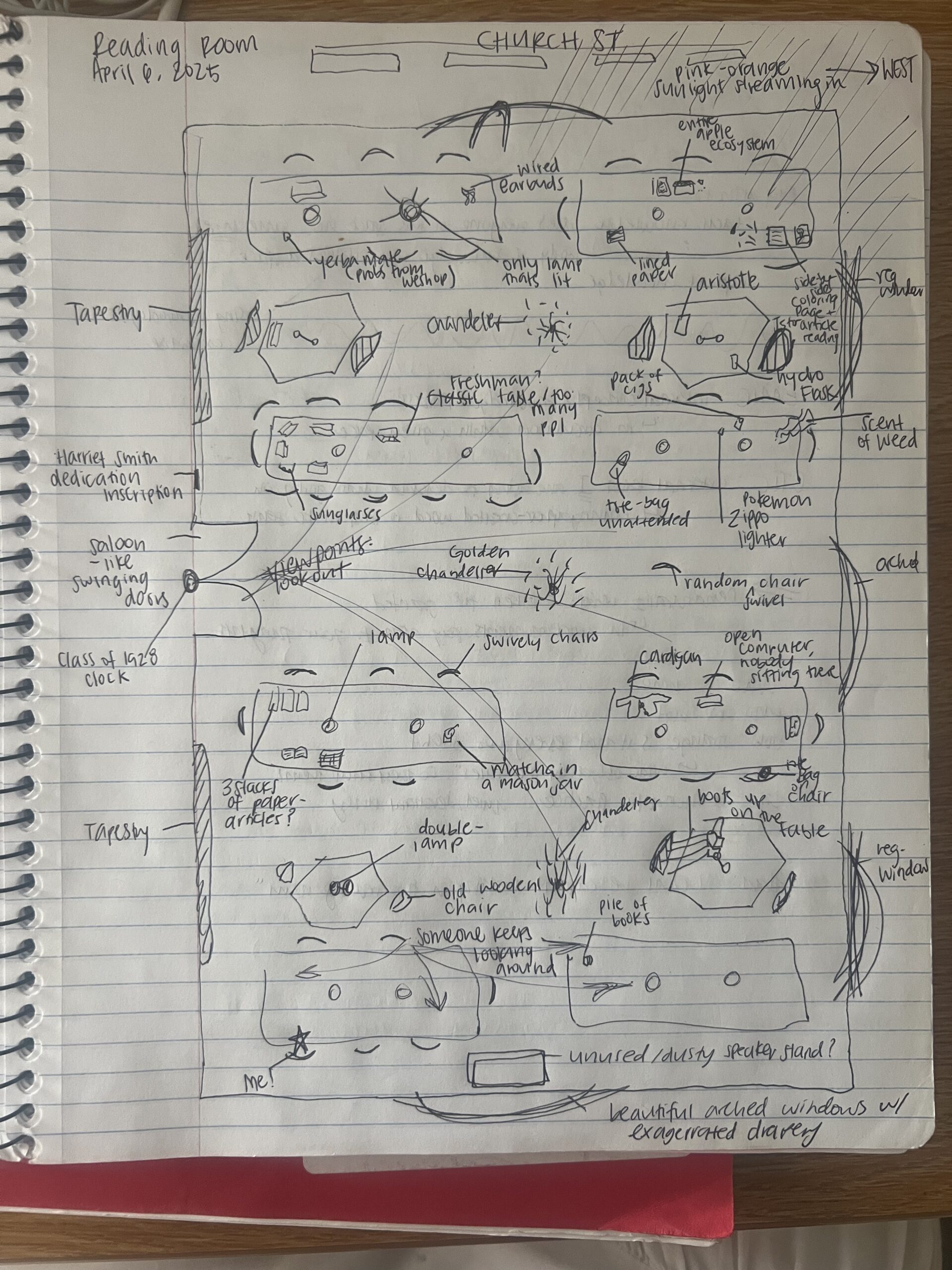
I turned instead to the infamous Smith Reading Room inside Olin, a place I occupied less over the semesters due to its oppressive silence. At first, I worried I had lost the intimacy of the archive; the chance to trace paper trails and speak with those who care for them. But in the reading room, I discovered another kind of archive: one written in silence.
The space itself is majestic—tall ceilings, oak tables, light that filters in like stained glass. Students walk softer here, carry themselves differently. In the absence of voices, other sounds rise: the clack of a pen, the warm hum of fluorescent bulbs, the thrum of comparison and inadequacy. Silence, I realized, is not nothing. It is a structure that organizes behavior, produces feeling, and shapes how people are seen.
What began as a setback became an experiment in storytelling; listening for the narratives that silence itself makes possible. My fieldnotes became a way to translate the ambient atmosphere into words, to make visible the subtle performances of posture, glance, and breath. This project showed me how much I enjoy finding overlooked details and transforming them into stories that reveal something larger.